


REMOTE PTZ OPERATION
Remote PTZ Operation and Multi Camera PTZ Control Architecture Guide
By Everet Envision · August 26, 2026
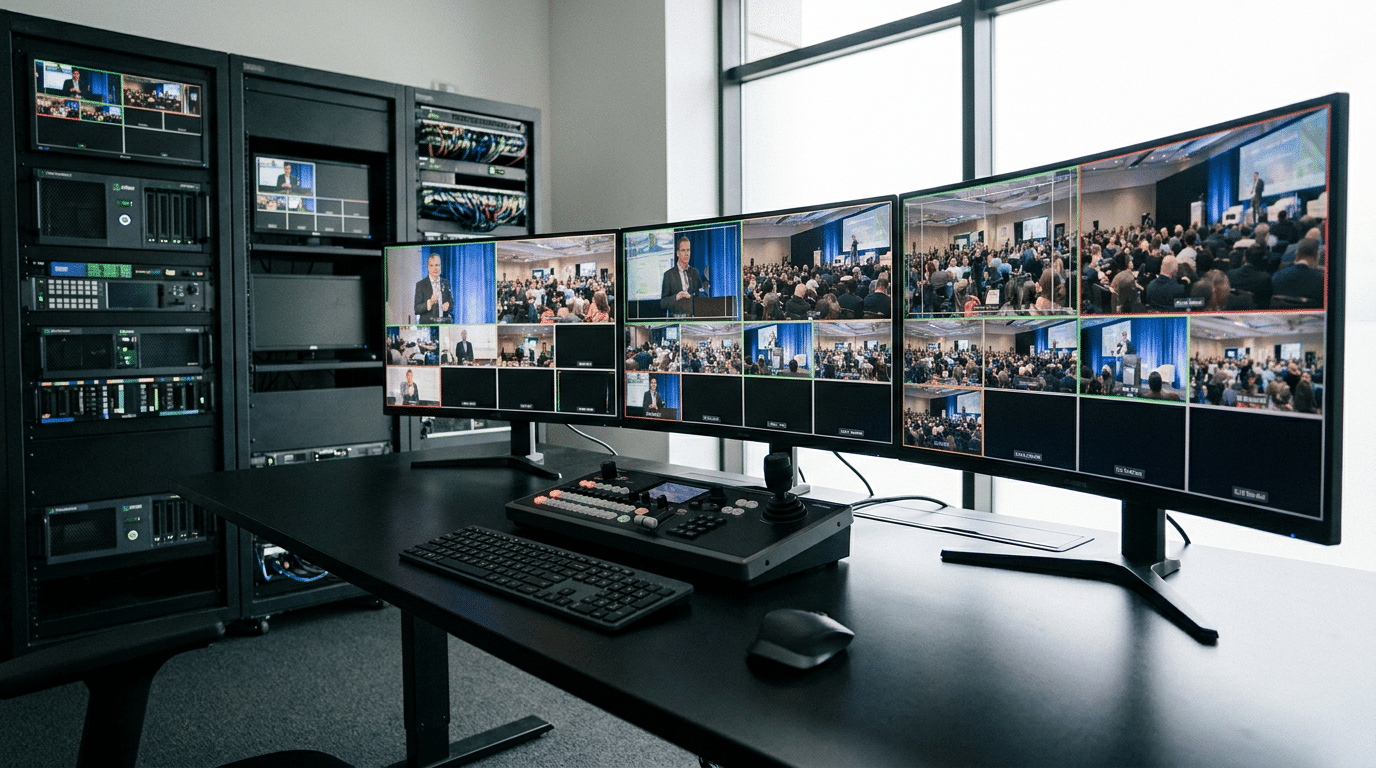
Remote PTZ operation enables technical operators, integrators, and broadcast crews to execute precise multi camera PTZ control over IP infrastructure, local networks, and cloud production workflow architectures without requiring physical manual camera operators at each camera position. In modern installations across churches, hybrid meeting rooms, higher education facilities, government council chambers, and live broadcast studios, cameras such as the Everet EVP312 Auto Tracking NDI|HX2 PTZ Camera with 12x Optical Zoom and the Everet EVX220 NDI®|HX3 Auto Tracking PTZ Camera 20x zoom deliver high-definition video over 3G-SDI, HDMI, USB, and IP streams using protocols like NDI|HX2, NDI|HX3, SRT, RTSP, and RTMP. Utilizing a hardware PTZ controller like the Everet EVKB200 NDI® PTZ Camera Controller alongside Power over Ethernet (PoE), single-cable deployments transmit video, tally, power, and bidirectional control commands directly over network switches. This setup simplifies NDI camera management, allowing centralized pan, tilt, zoom, and preset management from a central control room or remote production location.
Deploying Everet Imaging camera systems across multi-room environments requires structured IP planning to maintain low latency, predictable command transport, and synchronized video feeds. Products in the EVP NDI|HX2 Series provide versatile streaming via NDI bridge, SRT, and RTSP protocols, while hardware in the EVX NDI|HX3 SERIES delivers high-efficiency network video alongside physical 3G-SDI, HDMI, and USB outputs. Incorporating supported camera models within networked production infrastructure expands operational flexibility for remote PTZ operation across enterprise subnets. Connecting a dedicated hardware PTZ controller gives operators immediate tactile control over pan, tilt, optical zoom, auto tracking, and presets across multiple connected endpoints. Effective NDI camera management enables seamless coordination of multi camera PTZ control setups, optimizing signal distribution for cloud production workflow architectures.

Principles of Remote PTZ Operation in IP Video Infrastructure
Remote PTZ operation enables centralized multi camera PTZ control across local and wide area networks using hardware PTZ controllers, IP interfaces, and standardized transmission protocols. In environments such as houses of worship, hybrid meeting spaces, higher education venues, and live broadcast studios, cameras like the Everet EVP312 Auto Tracking NDI|HX2 PTZ Camera with 12x Optical Zoom and the Everet EVX220 NDI®|HX3 Auto Tracking PTZ Camera 20x zoom allow operators to adjust position, focal length, and camera settings over standard Ethernet connections utilizing Power over Ethernet (PoE).
Network Protocols and Signal Architecture
Modern IP video architectures depend on robust protocols to execute real-time camera commands while distributing video streams. Within the Everet Imaging product lineup, including the EVP NDI|HX2 Series and EVX NDI|HX3 SERIES, remote command distribution relies on NDI camera management and streaming protocols such as RTSP, RTMP, and SRT. Deploying a hardware PTZ controller such as the Everet EVKB200 NDI® PTZ Camera Controller provides dedicated remote control and direct access to presets, enabling seamless operation across complex production environments.
For remote PTZ operation extending beyond local networks, protocols like SRT and NDI bridge facilitate secure transport over WAN and cloud production workflow architectures. Integrated tally status feedback ensures operators maintain visual reference of active video sources, maintaining precise synchronization between off-site control hubs and physical camera installations.
Multi Camera PTZ Control and Network Control Protocols
Establishing efficient multi camera PTZ control across network infrastructure requires robust network control protocols designed for low-latency command execution and reliable video routing. In modern IP environments, remote PTZ operation relies on standardized network layers to communicate positioning, tally state, and video streaming data simultaneously. Systems engineered by Everet Imaging support versatile IP streaming frameworks including RTSP, RTMP, SRT, and NDI bridge. By leveraging NDI bridge technology, operators can extend signal distribution beyond local subnets into a cloud production workflow, enabling secure control and monitoring from off-site production facilities without compromising system responsiveness.
Hardware Control and Protocol Integration
For centralized NDI camera management, deploying a dedicated hardware PTZ controller provides tactile authority over complex production environments. The Everet EVKB200 NDI® PTZ Camera Controller integrates into network setups utilizing NDI|HX protocols and Power over Ethernet (PoE) for streamlined connectivity. Within this architecture, hardware controllers interface directly with units across product lines, such as the EVP NDI|HX2 Series—represented by the Everet EVP312 Auto Tracking NDI|HX2 PTZ Camera with 12x Optical Zoom—and the EVX NDI|HX3 SERIES, featuring the Everet EVX220 NDI®|HX3 Auto Tracking PTZ Camera 20x zoom, as well as supported camera models. Both the EVP312 and EVX220 offer Full HD video output across 3G-SDI, HDMI, IP, and USB interfaces, alongside supported features including PoE, tally, and 12x or 20x optical zoom capabilities respectively.

Hardware PTZ Controller Integration with the Everet EVKB200
In modern IP video production infrastructure, dedicated hardware PTZ controllers provide the tactile precision required for efficient multi camera PTZ control. The Everet EVKB200 NDI® PTZ Camera Controller integrates directly into local network architectures using native NDI|HX protocol support and Power over Ethernet (PoE). By utilizing PoE, the controller receives both operational power and network control data over a single network line, simplifying infrastructure deployment in remote PTZ operation environments.
A physical controller allows operators to select and manipulate multiple camera units across distinct IP network segments without relying solely on software interfaces. When deployed alongside cameras such as the Everet EVP312 Auto Tracking NDI|HX2 PTZ Camera with 12x Optical Zoom or the Everet EVX220 NDI®|HX3 Auto Tracking PTZ Camera 20x zoom, the hardware interface delivers direct physical feedback for critical optical adjustments and spatial tracking.
Key Hardware Integration Capabilities
Integrating a hardware controller like the EVKB200 into network production workflows establishes reliable physical control through documented system features:
- Single-Cable Power and Control — Power over Ethernet (PoE) support delivers power supply and control data over standard network cabling.
- NDI Camera Management — Native NDI|HX protocol communication enables unified control across units within the EVP NDI|HX2 Series and EVX NDI|HX3 SERIES.
- Direct Network Interoperability — Operates within standard network topologies to interface with IP cameras equipped with tally support and IP streaming functionality.
This dedicated hardware layer stabilizes multi-camera setups, allowing operators in broadcast studios, council chambers, and live event spaces to execute continuous pan, tilt, and zoom commands across the network with high accuracy.
Video Interfaces and Hardware Outputs across Everet Camera Series
The physical signal routing architecture of Everet Imaging PTZ camera models provides dedicated connectivity across broadcast, pro-AV, and IP network environments. Camera lines such as the EVP NDI|HX2 Series and EVX NDI|HX3 SERIES—including the Everet EVP312 Auto Tracking NDI|HX2 PTZ Camera with 12x Optical Zoom and the Everet EVX220 NDI®|HX3 Auto Tracking PTZ Camera 20x zoom—feature an identical video output layout comprising 3G-SDI, HDMI, IP, and USB interfaces for FHD image quality. These hardware outputs operate alongside IP streaming outputs to allow concurrent signal distribution across distinct production tiers.
Baseband outputs fulfill specific operational requirements within hardware environments: the 3G-SDI connection delivers digital video over coaxial cabling directly to broadcast switchers or SDI infrastructure, while the HDMI port feeds local monitoring setups or video presentation hardware. Simultaneously, the USB output provides connectivity directly to host capture systems, and the IP network interface routes stream data across local area networks or wide-area infrastructure for multi camera PTZ control.
Network Streaming Protocols and Hardware Capabilities
In addition to hardware baseband connections, the IP network interface on Everet Imaging cameras supports a robust set of network streaming standards designed for remote PTZ operation and cloud production workflow architectures:
- EVP NDI|HX2 Series Streaming — Incorporates NDI|HX2, RTMP, RTSP, SRT, and NDI bridge protocols, along with PoE power delivery and built-in tally integration.
- EVX NDI|HX3 SERIES Streaming — Supports high-efficiency NDI|HX3 alongside RTMP, RTSP, SRT, and NDI bridge protocols, with integrated PoE and tally support.
IP Streaming Protocols for Cloud Production Workflow Deployments
Modern cloud production workflow architectures rely on robust IP transport standards to transmit video signals and control data across wide area networks and local infrastructure. In remote PTZ operation environments, selection of the appropriate streaming protocol dictates how camera feeds are routed from physical venues to offsite production switchers or cloud platforms. Everet Imaging designs systems such as the EVP NDI|HX2 Series, including the Everet EVP312 Auto Tracking NDI|HX2 PTZ Camera with 12x Optical Zoom, and the EVX NDI|HX3 SERIES, including the Everet EVX220 NDI®|HX3 Auto Tracking PTZ Camera 20x zoom, to support versatile network protocol implementations. By utilizing standards like NDI|HX2 and NDI|HX3 alongside SRT, RTSP, and RTMP, operators maintain complete multi camera PTZ control and video feed access without relying on dedicated hardware tie-lines.
When routing video over public networks or between dispersed facilities, protocols like SRT and features such as NDI bridge address packet loss and traversal requirements across firewalls. The integration of NDI bridge directly complements NDI camera management strategies by bridging local network zones, enabling unified remote PTZ operation across remote studios, education centers, or house of worship facilities. For low-overhead local distribution, RTSP and RTMP protocols remain available across both the EVP NDI|HX2 Series and EVX NDI|HX3 SERIES. This multi-protocol approach ensures that whether a system connects to a hardware PTZ controller like the Everet EVKB200 NDI® PTZ Camera Controller locally via PoE or links into cloud-based switching software remotely, video transmission and camera command integrity are maintained without protocol lock-in.
Network Protocol Implementation in Everet Cameras
Deploying cameras into cloud infrastructures requires matching network capabilities with transmission requirements across local and wide area connections.
- NDI|HX2 and NDI|HX3 — Efficient IP streaming protocols utilized in the EVP NDI|HX2 Series and EVX NDI|HX3 SERIES for low-bandwidth video distribution and NDI camera management across IP networks.
- SRT and NDI bridge — Transport methods supported across Everet Imaging camera lines to facilitate secure WAN traversal and cloud production workflow integration over unmanaged internet connections.
- RTSP and RTMP — Standard streaming formats implemented for direct streaming server connections and local IP monitoring workflows.
Auto Tracking Functionality in EVP NDI|HX2 and EVX NDI|HX3 Series
The EVP NDI|HX2 Series and EVX NDI|HX3 SERIES from Everet Imaging integrate hardware-based auto tracking capabilities engineered to maintain consistent framing on moving subjects during remote PTZ operation. Models such as the Everet EVP312 Auto Tracking NDI|HX2 PTZ Camera with 12x Optical Zoom and the Everet EVX220 NDI®|HX3 Auto Tracking PTZ Camera 20x zoom automate pan, tilt, and zoom adjustments in real time. This automated target tracking reduces reliance on constant manual inputs from a hardware PTZ controller, simplifying operator workloads within multi camera PTZ control architectures where one supervisor manages several active room angles.
Integrated auto tracking operates seamlessly alongside broader NDI camera management infrastructures. The Everet EVP312 features 12x optical zoom and NDI|HX2 IP streaming, whereas the Everet EVX220 utilizes 20x optical zoom with NDI|HX3 protocol support. Both FHD PTZ camera models provide simultaneous 3G-SDI, HDMI, IP, and USB video interfaces, as well as RTSP, RTMP, SRT, NDI bridge capabilities, PoE, and tally indicators. When deployed within a local infrastructure or a remote cloud production workflow, auto tracking complements manual preset control from devices like the Everet EVKB200 NDI® PTZ Camera Controller across deployments utilizing the EVP NDI|HX2 Series or EVX NDI|HX3 SERIES hardware.
Deployment Standards for Integrators and Network Operators
System integrators and network operators planning infrastructure for Everet Imaging systems must evaluate network bandwidth, latency, and power distribution to ensure reliable remote PTZ operation. Deploying cameras across the EVP NDI|HX2 Series and EVX NDI|HX3 SERIES with Power over Ethernet (PoE) delivers video streams, control signals, tally indicators, and operational power over a single network cable. This reduces cable complexity in council chambers, lecture halls, and worship facilities while enabling structured multi camera PTZ control over local IP networks.
For effective NDI camera management, network operators should utilize managed network switches with Quality of Service (QoS) enabled to prioritize IP streaming protocols such as NDI|HX2, NDI|HX3, SRT, and RTSP. Connecting a hardware PTZ controller, such as the Everet EVKB200 NDI® PTZ Camera Controller, provides tactile control over IP connections, allowing operators to execute precise pan, tilt, and zoom movements across multiple camera endpoints.
Infrastructure Requirements for Cloud Production Workflow Integration
Integrating hardware into a cloud production workflow requires standardized video routing and protocol compatibility. Simultaneous physical outputs including 3G-SDI, HDMI, USB, and IP streaming on cameras such as the Everet EVP312 Auto Tracking NDI|HX2 PTZ Camera with 12x Optical Zoom and Everet EVX220 NDI®|HX3 Auto Tracking PTZ Camera 20x zoom support concurrent baseband monitoring and remote broadcast workflows.
- Power over Ethernet (PoE) — Delivers network power, control, tally status, and video transmission through a single network drop to streamline system deployment.
- Hardware PTZ Controller Integration — Utilizes network control protocols to link the Everet EVKB200 controller directly to camera endpoints for responsive multi-camera operation.
- Multi-Protocol Transport — Supports remote PTZ operation across local subnets and WAN environments using RTSP, RTMP, SRT, and NDI bridge protocols.
Remote PTZ Operation and Multi Camera PTZ Control Architecture Guide
Everet Imaging PTZ cameras, including models from the EVP NDI|HX2 Series and EVX NDI|HX3 SERIES, enable remote PTZ operation and multi camera PTZ control across studio, worship, government, and conference spaces using IP network protocols and hardware PTZ controllers. System operators manage video transmission and pan-tilt-zoom positioning via NDI|HX2, NDI|HX3, SRT, RTSP, RTMP, and NDI bridge protocols, while simultaneous physical video outputs such as 3G-SDI, HDMI, IP, and USB maintain direct local routing.
Architectures for multi camera PTZ control rely on IP networks to distribute telemetry, tally status, and video streams over standard Ethernet switches. Utilizing Power over Ethernet (PoE) allows a single network cable to deliver operational power, control commands, and video streams directly to units like the Everet EVP312 Auto Tracking NDI|HX2 PTZ Camera with 12x Optical Zoom and the Everet EVX220 NDI®|HX3 Auto Tracking PTZ Camera 20x zoom, streamlining multi-camera deployments in production networks.
In a government meeting hall or council chamber, wide room dimensions require fixed camera positions to capture both the rostrum and individual seats. An operator using the Everet EVKB200 NDI® PTZ Camera Controller manages multiple deployed units over IP, switching between wide architectural views and tight speaker framing using 12x optical zoom on the EVP312 or 20x optical zoom on the EVX220. Integrated tally lights confirm active transmission state directly on the camera hardware during live proceedings.
Key features
- NDI camera management — Native NDI|HX2 and NDI|HX3 IP integration allows control telemetry, tally feedback, and FHD video streaming over standard network connections.
- Hardware PTZ controller integration — The Everet EVKB200 NDI® PTZ Camera Controller delivers dedicated remote control options over NDI|HX and PoE infrastructure.
- Multi-interface video output — Simultaneous 3G-SDI, HDMI, IP, and USB interfaces provide local baseband monitoring alongside IP network encoding.
- 12x and 20x optical zoom options — Frame subjects at varying distances using the 12x optical zoom on the Everet EVP312 or the 20x optical zoom on the Everet EVX220 without software scaling.
- NDI bridge and cloud production workflow support — Built-in NDI bridge, SRT, RTSP, and RTMP streaming protocols allow video transport across local subnets and remote WAN cloud production workflow setups.
- Power over Ethernet (PoE) deployment — Power, tally, and IP stream transport operate over single cable runs to simplify network architecture and power management.
- Integrated hardware tally — Visual tally indicators built into the camera body provide immediate visual confirmation of active program status for presenters and crew.
- Auto tracking capability — Automated tracking functions assist operators by maintaining framing on moving presenters across worship, education, and studio environments.
IP Streaming and Multi Camera Control Protocols
Deploying remote PTZ operation across enterprise networks requires protocol flexibility for different network topologies. The EVP NDI|HX2 Series utilizes NDI|HX2 alongside SRT, RTSP, and RTMP for bandwidth-efficient transmission over local and wide area networks. The EVX NDI|HX3 SERIES incorporates NDI|HX3 to deliver high-quality video encoding with low network latency requirements.
For remote sites and multi-location setups, NDI bridge capabilities allow NDI video and control data to pass securely across network boundaries, supporting off-site production nodes and cloud production workflow environments. In setups requiring traditional baseband connections alongside network infrastructure, 3G-SDI and HDMI outputs provide local feeds to production switchers or monitors while IP streams feed encoding destinations.
Hardware Controllers vs Software NDI Management
Precise control in live multi-camera environments relies on tactile hardware interfaces. A hardware PTZ controller like the Everet EVKB200 NDI® PTZ Camera Controller provides dedicated camera control functions powered via PoE. Operating over NDI|HX, the EVKB200 connects directly to network infrastructure, allowing operators to execute pan, tilt, zoom, and preset selection across multiple active cameras on the network.
Software-based NDI camera management tools complement hardware controllers by providing centralized network discovery, device configuration, and remote administration via standard web interfaces. This dual approach allows operators to maintain physical control during live execution while administrators manage network parameters and stream settings remotely.
For integrators and resellers
Integrators planning multi camera PTZ control systems can specify Everet Imaging models based on space requirements, optics, and networking protocols. The Everet EVP312 Auto Tracking NDI|HX2 PTZ Camera with 12x Optical Zoom (available in black EVP312 and white EVP312W) and the Everet EVX220 NDI®|HX3 Auto Tracking PTZ Camera 20x zoom (available in black EVX220 and white EVX220W) both offer FHD image output, integrated tally, PoE support, and multi-port connectivity (3G-SDI, HDMI, IP, and USB). Remote control and power are centralized through standard network infrastructure alongside the Everet EVKB200 NDI® PTZ Camera Controller. Installers can integrate these cameras into established NDI workflows using RTSP, RTMP, SRT, NDI|HX, and NDI bridge protocols.
Selecting appropriate optical zoom parameters and IP control protocols ensures robust remote PTZ operation and seamless scalability across multi-camera installations.
Frequently asked questions
How does the Everet EVKB200 hardware PTZ controller integrate into an IP network?
The Everet EVKB200 NDI PTZ Camera Controller supports NDI|HX protocols and Power over Ethernet (PoE) for network connectivity. This allows operators to perform multi camera PTZ control and NDI camera management over local network infrastructure using a single Ethernet cable for power and control signals.
Which IP streaming protocols are available on the EVP312 and EVX220 cameras?
The Everet EVP312 supports NDI|HX2, RTMP, RTSP, SRT, and NDI bridge protocols. The Everet EVX220 supports NDI|HX3, RTMP, RTSP, SRT, and NDI bridge protocols. These standards enable video transport across local IP networks and remote cloud production workflows.
What video outputs and physical connections are available on Everet PTZ cameras?
Everet EVP312 and EVX220 PTZ cameras feature 3G-SDI, HDMI, IP, and USB video interfaces. Both models support PoE power options and tally indicators, housed in black or white enclosures.
What optical zoom specifications do the EVP NDI|HX2 and EVX NDI|HX3 models provide?
The Everet EVP312 Auto Tracking NDI|HX2 PTZ camera features a 12x optical zoom lens. The Everet EVX220 NDI|HX3 Auto Tracking PTZ camera features a 20x optical zoom lens. Both models capture full HD image quality.
